Exploring Android Bench 2.0: A New Era for AI in Development
Introduction to Android Bench 2.0
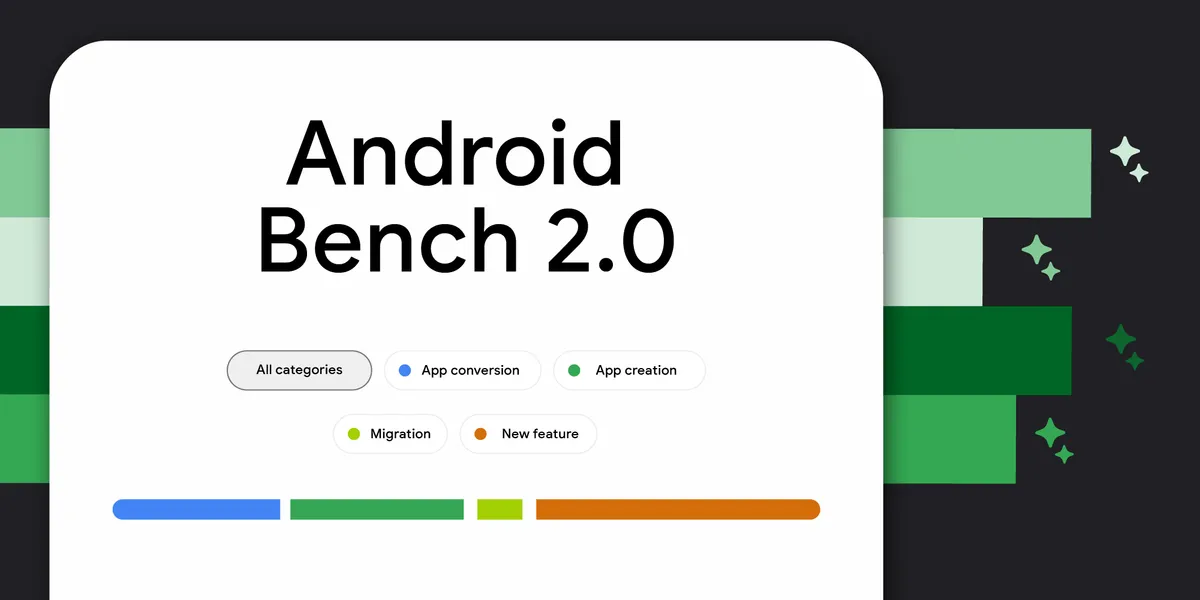
Android Bench has undergone a significant transformation with the introduction of Android Bench 2.0, which focuses on evaluating the capabilities of large language models (LLMs) in handling complex Android development tasks. This update reflects the rapid evolution of AI models and aims to align the evaluation framework with the Harbor framework, setting higher standards for AI-assisted development.
What’s New in Android Bench 2.0
The major upgrade brings forth a set of long-horizon tasks (LHTs) that are designed to challenge AI models in ways that mirror real-world engineering scenarios. These tasks are intricate and can take days or even weeks for developers to complete. The new approach also introduces agentic evaluation, which involves assessing agents provided by corresponding model developers.
Long-Horizon Tasks Explained
Long-horizon tasks are a step up from the previous benchmarks, which primarily focused on incremental changes such as bug fixes or minor feature enhancements. The LHTs encompass various complex challenges like upgrading dependencies, adding new functionalities, and even building applications from scratch. This shift reflects a broader ambition to evaluate AI capabilities more comprehensively.
Continuous Scoring for Better Insights
One of the key changes in Android Bench 2.0 is the move from binary pass/fail grading to a continuous scoring system. This new method provides a more nuanced understanding of model performance on multi-day tasks. For instance, a model that successfully completes 90% of the requirements might still face penalties for failing to meet specific edge-case assertions. This continuous scoring approach combines various factors, including functionality, visual fidelity, and adherence to structural constraints, to deliver a more accurate assessment of AI models.
Performance Metrics and Insights
The performance of AI models on long-horizon tasks has revealed some intriguing insights. The highest pass rate for these tasks is approximately 28%, a stark contrast to the 91% pass rate seen in earlier benchmarks. This highlights the increased complexity and the challenges models face when tackling more intricate engineering tasks.
Strengths and Weaknesses of AI Models
The evaluation has shown that AI models excel at writing new code, particularly when it involves well-defined transformations, such as converting Java to Kotlin or integrating a ViewModel layer. However, the models encounter difficulties with tasks that require runtime validation or involve significant architectural changes. Notably, the challenge of porting cross-platform applications to Android remains a tough nut to crack, with no model achieving a 100% pass rate.
Agentic Evaluation and Future Directions
To enhance the evaluation process, Android Bench 2.0 incorporates commonly used agents into its assessments. By pairing models with their respective agents, the evaluation aims to provide insights into how these combinations can improve development outcomes. For example, models like GPT 5.6 Sol and Gemini 3.8 Flash have been tested against long-horizon tasks, showcasing how effective design can lead to better results in development workflows.
Expanding the Leaderboard
The leaderboard has also been updated to include new models, such as Gemini 3.8 Flash, OpenAI’s GPT-6, and Anthropic’s Fable 5.1, among others. With OpenAI’s GPT-6 Astra leading the pack at a 28% pass rate, developers now have access to a more comprehensive view of model performance, assisting them in making informed choices for their projects.
Conclusion
Android Bench 2.0 represents a significant advancement in evaluating AI capabilities for Android development. By focusing on long-horizon tasks, continuous scoring, and incorporating agentic evaluations, this platform aims to empower developers with better tools and insights. As the landscape of AI-assisted coding continues to evolve, Android Bench will play a crucial role in guiding developers toward the most effective AI solutions for their needs.
Source for the original facts: Original source.